



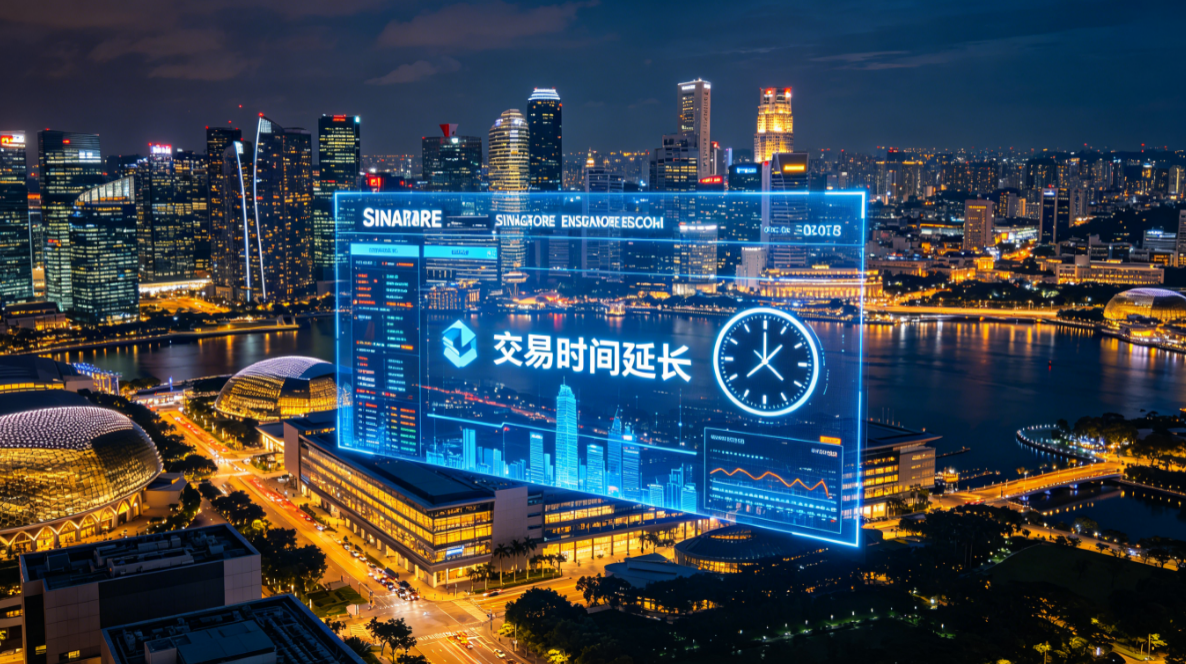
Singapore Exchange Considers Extending Trading Hours: A "Time War" to Compete for Liquidity and International Capital
Keywords: Singapore Exchange, trading hours extension, market liquidity, international investors, Asian financial center, stock market competitiveness
Recently, news that the Singapore Exchange (SGX) may extend trading hours has attracted considerable market attention. It sounds like a very technical adjustment, but if you look deeper, it is not just about "keeping the doors open a few more hours"; it is a strategic move by Singapore's capital market to reposition itself in the global financial landscape.
Extending Trading Hours: Surface "Open Longer," Behind the Scenes Compete for Flow
According to current information, SGX is studying plans to extend trading hours, possibly aligning the trading session with the Hong Kong Exchange. The core purpose of this move is clear: to enhance market liquidity and attract more international investors.
Why are trading hours so important? Because financial markets ultimately compete on "convenience" and "efficiency." For many cross-border funds, if the exchange's opening hours do not match their working hours, operations become cumbersome. Especially for European and American institutional investors, Asian market trading hours are already early, and adding time zone differences makes timely order placement, position adjustment, or risk hedging less convenient.
Therefore, extending trading hours is a very practical move: to make more funds willing to stay, enter, and spend more time in the Singapore market.
Why Now? Singapore Cannot Just Rely on "Stability"
Singapore's financial market has always been known for being stable, regulated, and highly internationalized, but in terms of "heat," it still lacks a bit of explosive power compared to some more active markets. Over the past few years, global capital allocation patterns have been constantly changing, and competition among Asian markets has become increasingly evident. Hong Kong, Tokyo, Seoul, Shanghai, Shenzhen and other markets are all making moves around liquidity, technology upgrades, and investor experience. If Singapore remains in its traditional rhythm, its appeal will inevitably be partially diverted.
SGX studying extended trading hours at this time indicates to some extent that it recognizes a problem: having institutional advantages is not enough; the market also needs to be "more user-friendly." After all, for institutional investors, time is cost; for retail investors, convenience directly affects willingness to participate.
In other words, adjusting trading hours is not a minor fix; it is an effort by Singapore to make its financial market more "round-the-clock" and more "international."
Will Extending Trading Hours Really Bring Liquidity?
The answer is: possible, but not automatic.
Longer trading hours theoretically allow investors in different regions to participate more easily, especially institutions and professional traders who need to operate across time zones. If more people are willing to trade, trading volume can usually increase, and market depth may also improve. For some international funds, being able to place orders at more suitable times indeed increases positive sentiment toward that market.
However, liquidity cannot be fully resolved simply by "lengthening the clock." What really determines whether funds are willing to stay is the market's own appeal, such as the quality of listed companies, valuation levels, transaction costs, regulatory environment, derivatives support, and overall market activity.
In other words, extending trading hours is more like a "bonus factor" than a "master key." If trading hours are simply lengthened without a corresponding increase in market participation, the result may just be a busier exchange without many more investors.
For Singapore, This Is a Comprehensive Competition
From a broader perspective, SGX's move actually reflects the increasingly fierce competition among Asian financial centers. Modern capital markets no longer compete only on scale, but also on service, efficiency, and time zone adaptability.
If SGX can smoothly implement the extension of trading hours, and combine it with smoother trading systems, friendlier market rules, and more attractive product structures, its status in the eyes of international investors is likely to improve further. Especially in the context of global funds paying more attention to risk diversification and regional allocation, Singapore, with its political stability, sound legal system, and high degree of internationalization, already has a good foundation.
The only question is: can it truly translate this "foundation" into "trading volume" and "attention"?
Conclusion: Time Is Not Just Time, It Is Competitiveness
On the surface, SGX extending trading hours is just an operational adjustment; but in essence, it is an attempt by Singapore's financial market to proactively adapt to the global investment pace. For a market that hopes to continue playing the role of an important Asian financial hub, any change that can enhance liquidity, facilitate trading, and increase international appeal deserves serious consideration.
Of course, the final effect depends on how the specific plan is implemented and whether market participants truly buy in. Details expected to be released within the year will become important signals for observing the next direction of Singapore's capital market.
It is foreseeable that the future Singapore Exchange may not just "keep doors open longer" but aim to make global funds feel: it is more worth coming to, and more worth staying.