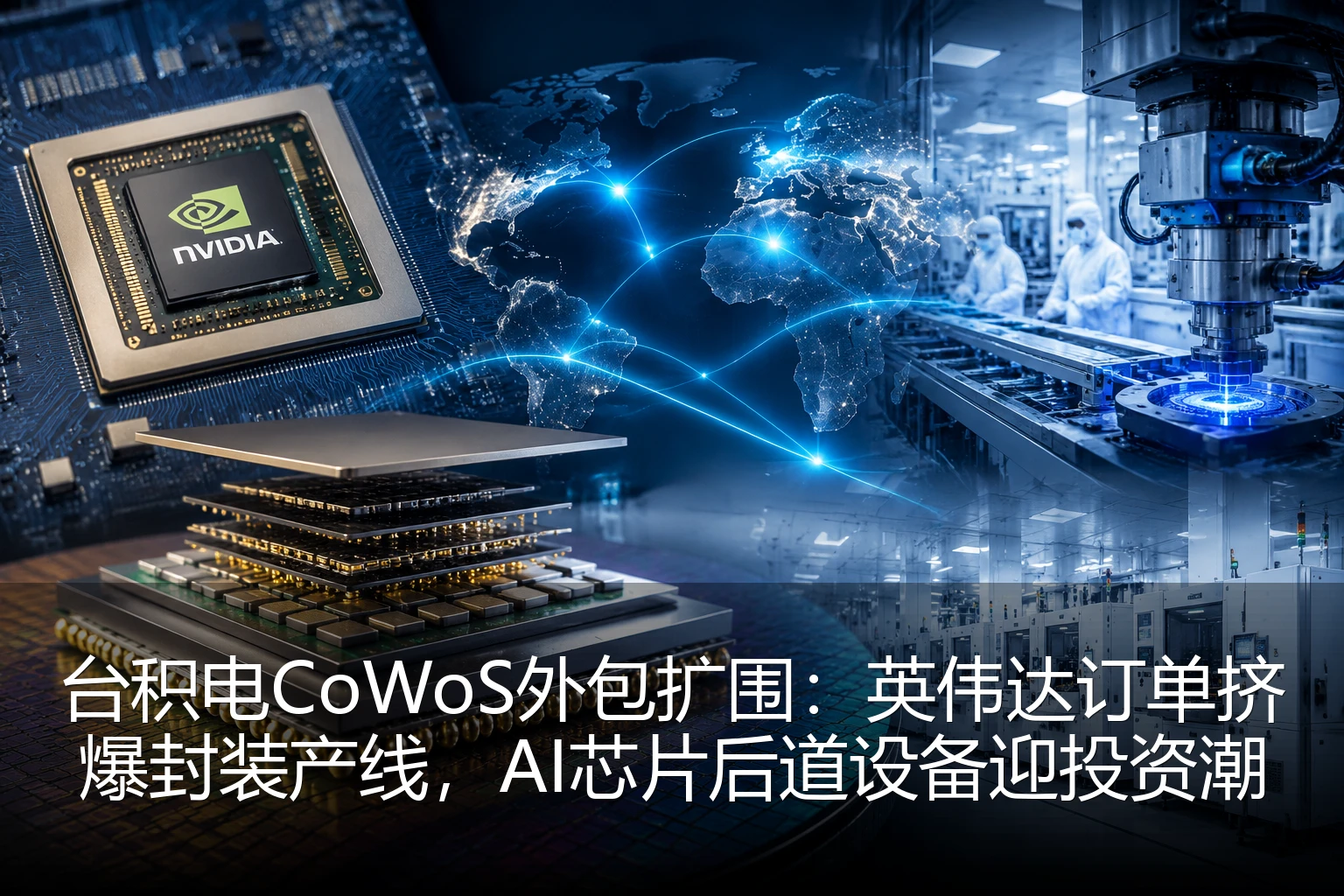



TSMC CoWoS Outsourcing Expansion: Nvidia Orders Overload Packaging Lines, AI Chip Back-End Equipment Sees Investment Boom
The global AI chip supply chain is undergoing a profound "capacity redistribution." As of early August 2026, based on various market reports and coverage from South Korea's Electronics News, with NVIDIA's GPU orders pushing TSMC's advanced packaging lines to the limit, TSMC has decided to further massively outsource the CoW (Chip on Wafer) process within CoWoS packaging technology to OSAT vendors such as ASE Group. Market estimates suggest a shortage in AI chip packaging capacity of approximately 20%. This strategic shift marks a turning point in resolving the AI chip packaging capacity bottleneck, moving from "in-house expansion" to "joint outsourcing," and opens a new boom window for the back-end equipment industry in the global semiconductor sector.
CoWoS Packaging: The "Throat" of AI Chips
To grasp the significance of this news, one must first understand what CoWoS is. CoWoS is an advanced 2.5D packaging technology specifically designed by TSMC for AI chips. Its process centers around AI processors like GPUs (SoCs), which are surrounded by High Bandwidth Memory (HBM) and interconnected at high speed via a silicon interposer. The entire process can be broken down into two main stages: CoW, which is the bonding and interconnection of the chip and the interposer; and WoS (Wafer on Substrate), which is the joining of the interposer and the main substrate.
For many years, TSMC primarily entrusted the relatively mature WoS stage to OSAT companies like ASE, Amkor, and SPIL, authorizing them to handle production. However, the scale of outsourcing for the more technically demanding CoW stage has always been extremely limited. In other words, CoW is the true "bottleneck" in CoWoS capacity expansion—it directly determines how many AI chips can be produced each month. TSMC's significant opening of CoW outsourcing is akin to "opening the floodgates" for the AI chip supply side.
Why Expand Now? AI Demand Has "Maxed Out" the Lines
The immediate catalyst for this expansion is the continuous explosion in AI chip demand. On one hand, AI chip designers, led by NVIDIA, have booming orders, and GPU demand has pushed TSMC's packaging lines to their limits. On the other hand, major AI data center operators are rapidly developing and deploying custom chips (ASICs), causing a sharp rise in overall advanced packaging demand. TSMC currently accounts for an estimated 90% of the global AI chip manufacturing market share, yet the bottleneck in the packaging stage has not been fundamentally resolved, even with TSMC's continued investment in packaging capacity.
Against this backdrop, TSMC chooses "cooperation" over "solitary effort": jointly increasing capacity with key partner OSAT vendors. Industry insiders point out that this expansion of outsourcing is an active attempt by TSMC to scale up with OSAT partners amid continuously growing market demand. For TSMC, releasing some CoW processes to external partners can more quickly supplement capacity elasticity; for OSAT vendors, it means upgrading from a "supporting role" to a critical link in the AI chip supply chain, leading to a simultaneous rise in technical content and added value.
The Ripple Effect: A Surge in Back-End Equipment Investment As OSAT enterprises taking on CoW processes accelerate capacity expansion, demand for back-end process equipment is expected to benefit first. According to several industry insiders in South Korea's equipment sector, negotiations for CoW-specific equipment in the laser processing and bonding fields are currently underway, with investment focus expected to concentrate on wafer and interposer cutting, and bonding processes. Relevant OSAT companies are actively ordering equipment to build new production lines and have commenced procurement order consultations with local Korean material, component, and equipment companies. Although the specific investment scale has not been disclosed, the industry anticipates that the related manufacturers will significantly expand their existing capacity, leading to a considerable scale of equipment procurement demand.
This wave of spillover effect is spreading across Asia. Southeast Asia, as a major base for global semiconductor packaging, testing, and precision manufacturing, is expected to undertake some capacity transfer and supporting demands. Singapore, as a hub for regional semiconductor equipment, testing, and precision components, also holds a unique position in this "back-end arms race."
SGX Perspective: The Beneficiary Logic of the Singapore Semiconductor Chain
For mainboard investors in Singapore, this news reconfirms the "long slope and thick snow" demand for AI chips. Although Singapore is not a major wafer fabrication center, it is deeply embedded in the global AI supply chain in the semiconductor back-end process equipment, testing, and precision component segments. Several semiconductor-related companies listed on the SGX mainboard—such as testing equipment provider AEM Holdings (SGX: AWX) and precision component supplier UMS Integration (UMS Holdings)—have deep collaborations with global top-tier equipment and packaging giants. In fact, in the first half of 2026, the stock prices of Singaporean semiconductor entities like AEM, UMS, Frencken Group, and Nanofilm all increased by more than double, far exceeding the approximately 13% rise of the Straits Times Index during the same period. The continuous inflow of foreign capital is a direct reflection of the AI boom being transmitted to the SGX.
From a broader perspective, TSMC's expansion of outsourcing reveals an important investment logic: the competition for AI chips has extended from front-end processes to back-end packaging, and advanced packaging is becoming a key variable in determining the supply elasticity of AI chips. For SGX investors, besides tracking the orders and performance guidance of overseas leaders like TSMC and NVIDIA, it is also important to pay attention to potential beneficiaries in the "bottleneck" links of the industry chain—whether OSAT packaging and testing plants, laser, bonding, and inspection equipment manufacturers, or precision component and material suppliers, all have the opportunity for value reassessment in this cycle of capacity expansion.
Investment Insights: Monitoring Order Visibility to Grasp the Balance Between Boom and Valuation
* Monitor the order transmission rhythm: The process from OSAT capacity expansion to capacity release typically takes several quarters, so investors should track the changes in backlog and performance guidance of related equipment and precision component companies.
* Be wary of cyclical fluctuations: Semiconductor equipment investment has a distinct cyclical nature, and a concentrated release of capacity may lead to temporary supply gluts; high-valuation stocks require careful decision-making based on order visibility.
* Grasp regional opportunities: The increasing demand for packaging, testing, and equipment support in Southeast Asia warrants continuous tracking of the profitability elasticity and foreign capital flows of Singaporean semiconductor industry chain stocks. In summary, TSMC's CoWoS outsourcing expansion is not a simple "capacity relocation," but a structural reorganization of the AI chip supply chain under intense demand pressure. For Singaporean investors observing the global semiconductor industry chain, this serves as a vivid case study for understanding the main trend of AI investment and an important clue for tracking sector capital flows and performance realization.
Disclaimer: This content is for reference only and does not constitute investment advice. Investment involves risks, please proceed with caution.