



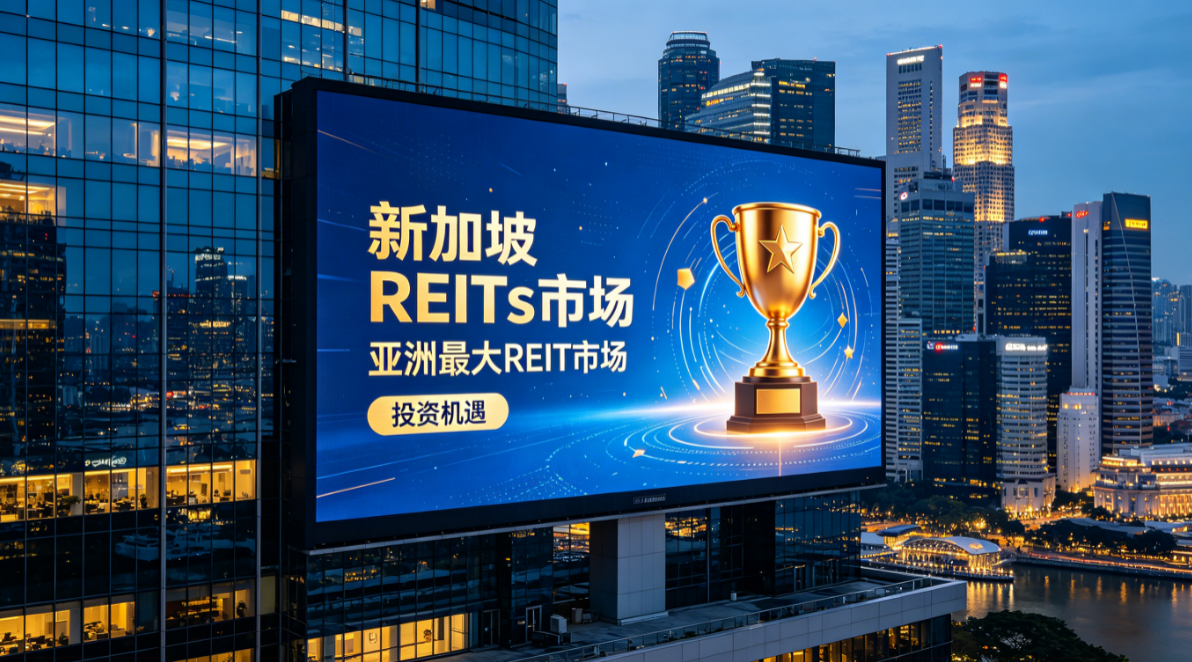
Singapore REITs: "Rental" Opportunities in Asia's Strongest Market – Are They Really That Attractive?
Keywords: Singapore REITs, Singapore real estate trust, dividend yield, Asian REIT market, asset allocation, investment risk
In the global investment market, if you want a tool to share real estate returns without being a landlord yourself, Singapore REITs are definitely worth a serious look. Many people's first reaction to "real estate trust" is "too complicated" or "high threshold." Actually, it's not. The logic of Singapore REITs is simple: package high-quality real estate assets for listing, and investors indirectly enjoy rental income and asset appreciation by buying units. In short, participate in real estate investment in a more relaxed way.
1. Why Did Singapore Become the Asian REIT Center?
The strength of Singapore's REITs market boils down to three words: mature, stable, transparent.
Currently, Singapore has over 40 listed REITs with a total market cap exceeding S$100 billion, ranking first in Asia by scale. This achievement is not accidental but the result of years of institutional construction and market cultivation.
Most Singapore REITs focus on commercial real estate, with rich asset types including malls, offices, industrial estates, hotels, data centers, and healthcare assets. Such a diversified structure means investors are not putting all eggs in one basket but spreading across multiple industries and regions, enhancing risk resistance. Especially when the economic cycle changes, different types of assets often perform differently, which is very important for long-term investors.
2. Why Do Many People Like to Allocate Singapore REITs?
The most direct attraction is strong "cash flow feeling."
Singapore REITs typically require distributing most distributable income to investors, so dividend yields often reach 4%-6%, quite attractive in the current environment of relatively low returns on many traditional assets.
In addition, they have several practical advantages:
1. Stable rental income
The underlying assets are mostly mature properties, with tenants mostly enterprises or brands, and relatively long lease terms, making income source stable. For those who like "visible cash flow," this model is more solid than pure speculation on themes.
2. Professional management team
Ordinary people buying and renting out property have to worry about tenants, repairs, vacancy rates, taxes, etc.; REITs are run by professional management teams responsible for operations, leasing, and asset optimization, saving a lot of trouble. Investors only need to focus on asset portfolio and dividend performance, not on whether the roof leaks.
3. Sound regulation and transparent information
Singapore's financial regulatory system is mature, with strict disclosure requirements for REITs. Investors can clearly see key data such as assets and liabilities, rental coverage, occupancy rates, and debt structure. This transparency is crucial because REITs are essentially "financial report-based" investments; the clearer the information, the easier to assess risks.
4. Easy asset allocation
If you already have stocks, bonds, and other assets, Singapore REITs can serve as a good supplement. They have both yield attributes and asset allocation functions, especially suitable for those seeking stable cash flow without bearing too much volatility.
3. Don't Just Look at Returns, Understand the Risks
Any investment is not without risk. Singapore REITs are no exception. The most common risks fall into three categories.
1. Interest rate rise risk
REITs typically use leverage. When interest rates rise, financing costs increase, potentially compressing distribution space. Simply put: borrowing becomes more expensive, squeezing profits.
2. Asset type differentiation
Different REITs vary greatly in performance. For example, mall REITs are affected by consumption environment, office REITs by office supply-demand, hotel REITs by tourism and business travel recovery. In other words, don't generalize because they are all REITs.
3. Exchange rate fluctuations
If investors use other currencies to allocate Singapore REITs, exchange rate changes also affect final returns. Profitability sometimes depends not only on dividends but also on exchange rates.
4. Who Is It Suitable For?
Singapore REITs are more suitable for those seeking stable returns, valuing cash flow, and willing to hold long-term. If you want more "rental type" assets in your portfolio and less high-volatility excitement, they are a good choice.
But if you expect short-term surges, REITs may not be that "exciting." Their appeal is not in doubling overnight, but in long-term stability, consistent payouts, and gradual accumulation.
Conclusion
Overall, the reason Singapore REITs have become Asia's largest REIT market is not just their size, but their combination of institutional maturity, high-quality assets, stable dividends, and transparent information. For investors seeking stable returns globally, it is indeed a direction worth studying.
Of course, REITs are not a "buy blindly" magical asset; factors like interest rates, industry cyclicality, leverage levels, and exchange rates must all be considered. The truly smart approach is not to chase the highest returns, but to find the assets that best match your risk preferences. After all, in investing, if you can sleep well at night, you have truly earned.