


Optimus 3 Production Nears: Humanoid Robot Supply Chain Accelerates, Industry Chain Enters Key Verification Phase
Keywords: humanoid robot, Optimus 3, harmonic reducer, joint module, machine vision, supply chain, industry chain investment
Introduction
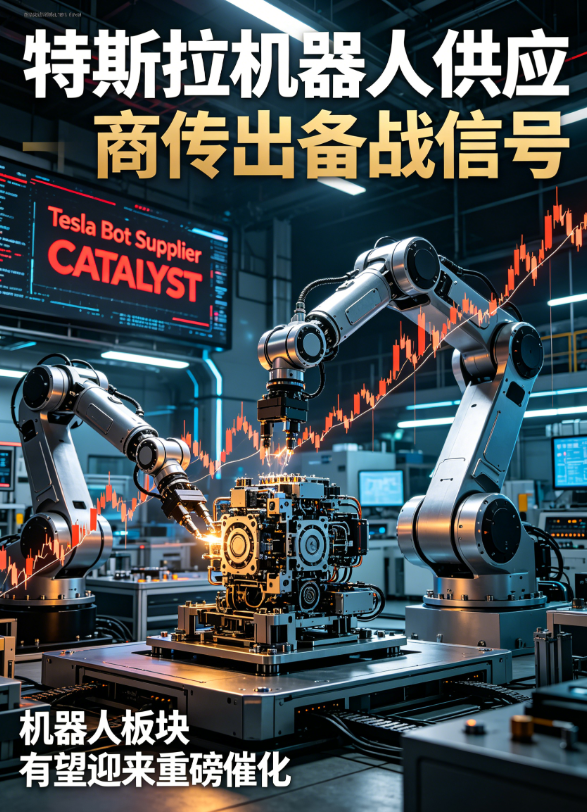
As Tesla's humanoid robot Optimus 3 production plan becomes clearer, the global robot industry chain is entering a new phase of expectation realization. Recent reports indicate that automation equipment suppliers Mirle and Asia Optical are set to go all out in the second half of the year to support the mass production of Optimus 3. Mirle's Taiwan plant has begun supplying key harmonic reducers and joint modules, while Asia Optical is responsible for producing the robot's "eyes" – high-resolution, high-precision lenses.
This means Optimus 3 is no longer just a concept product; it is steadily advancing along the path of "component introduction – production line setup – capacity ramp-up." For the industry chain, this is not only the realization of a single order but could become an important inflection point from technical verification to volume manufacturing for humanoid robots.
Main Content
1. Optimus 3 Production Advances, Industry Chain Enters Realization Window
According to Musk's previous plan, the Optimus 3 production line is expected to start at the California factory around the end of July or August, with further capacity expansion at the Texas factory next summer, a long-term goal of 10 million units per year. Although this goal still faces multiple challenges such as technical maturity, manufacturing yield, cost control, and supply chain stability, the signal it sends is clear: Tesla is pushing humanoid robots into mass production using the logic of automotive industrialization.
In the humanoid robot industry, what really determines the pace of commercialization is not just the complete machine solution, but the maturity and supply stability of core components. Components such as harmonic reducers, joint modules, servo systems, sensors, and vision modules directly affect the robot's flexibility, precision, response speed, and stability. Mirle and Asia Optical each cut into high value-added segments, indicating that Optimus 3's supply chain system is accelerating and reflects Tesla's great emphasis on localization, scale, and cost optimization of key components.
2. Domestic and Taiwanese Component Support Opens Manufacturing Space for Humanoid Robots
From an industry division perspective, the harmonic reducers and joint modules supplied by Mirle are core components of the humanoid robot execution layer. Harmonic reducers are small in size, high in transmission ratio, and accurate, forming the basis for fine robot movements; joint modules are equivalent to the robot's "muscles and joints," determining motion smoothness and load capacity. Whoever can achieve high precision, low cost, and high stability mass production of these core components will have a better chance to enter the core circle of the humanoid robot industry chain.
Asia Optical mainly provides high-resolution, high-precision lenses for robot eyes. For humanoid robots, the vision system is no less important than the mechanical structure. Robots need visual perception to understand the environment, recognize objects, judge distances, and plan actions; lens performance directly determines the upper limit of perception capabilities. As humanoid robots move from labs to factories, warehouses, and home scenarios, vision modules and perception systems will become key variables determining the speed of application deployment.
Notably, the entry of Taiwanese companies is not accidental. Taiwan has deep accumulation in precision manufacturing, automation equipment, optical components, and electromechanical integration, with strong industrial synergy. The current push of the Optimus 3 supply chain actually provides these companies with an important window to enter the global high-end robot market.
3. A-Share Related Companies Accelerate Layout, Industry Chain Investment Logic Becomes Clearer
From the A-share market perspective, layout around the humanoid robot industry chain is deepening. Kedali announced on June 16 that it plans to jointly invest with Taiwan Mirle and Taiwan Mingying to set up Thailand Comeng Innovation Robot Technology Co., Ltd. in Thailand and build a harmonic reducer production base in Thailand. This move is typical: on one hand, it shows that domestic enterprises are improving global supply capacity through overseas production layout; on the other hand, it means that the industrialization of core components for humanoid robots has moved from "technical reserves" to "capacity landing" stage.
Kedali itself has strong manufacturing foundations in precision structural parts. This joint factory setup helps it further expand business boundaries in the robot core transmission system. For supply chain companies, entering the customer systems of leading companies like Tesla often means that technical standards, delivery capabilities, and quality systems have undergone stricter verification, which will in turn raise the competitive threshold in the industry.
At the same time, Leaderdrive's layout in the field of embodied intelligence is also systematic. Around precision transmission solutions, it has formed a complete system covering "technology R&D - product adaptation - supply chain integration," not only covering lightweight and miniaturized products but also actively advancing layout of core components such as electromechanical integration and planetary roller screws. For humanoid robots, miniaturization, high responsiveness, and high reliability of transmission systems are the foundation for large-scale application; whoever can continuously break through in these directions will be more likely to seize the initiative in future industrial competition.
4. From Theme Speculation to Performance Realization, Market Focus Is Shifting
Huaxin Securities Lin Zijian suggests prioritizing T-chain deterministic targets before V3 launch; if the actual launch effect exceeds expectations, it will bring sector-wide beta opportunities; meanwhile, attention should be paid to robot manufacturers that have already achieved pilot deployment in industrial scenarios and have first-mover advantages. This view has strong practical significance.
In the past, the humanoid robot sector was more driven by concepts, with market focus concentrated on technical demonstrations, prototype showcases, and long-term visions. But as Optimus 3 production date approaches, the investment logic is shifting from "storytelling" to "delivery," from "expectation" to "order." At this stage, truly deterministic companies are those that can enter the OEM supply chain, have mass production capabilities, possess technical accumulation, and have completed pilot verification.
More importantly, the humanoid robot industry chain is not a single point breakout but a systemic upgrade. Upstream materials and precision components, midstream body manufacturing and control systems, and downstream scenario applications and data loops will jointly determine the speed of industry growth. In the short term, the market will focus on Tesla order expectations and industry chain expansion moves; in the medium to long term, the industry will ultimately return to the comprehensive competition of cost, yield, scale, and application value.
Conclusion
The acceleration of Optimus 3 production marks the transition of humanoid robots from technical demonstration to industrial verification. Supply actions by Mirle and Asia Optical, as well as forward-looking layouts by listed companies like Kedali and Leaderdrive, show that the industry chain is gathering around core components and manufacturing links.
In the coming period, opportunities in the humanoid robot sector will come more from actual order realization, capacity ramp-up, and scenario verification. For the market, what really deserves attention is not just whether a certain robot can be launched, but whether the supply chain behind it already has large-scale manufacturing capabilities. As the industry enters a realization period, companies with technical barriers, manufacturing capabilities, and customer certainty are expected to first share the long-term dividends brought by this emerging industry's growth.