



Singapore Stock Market Hits New High: Financials and REITs Jointly "Rally", What Is the Market Optimistic About?
Keywords: Singapore stock market, Straits Times Index, financial stocks, REITs, DBS Bank, OCBC Bank, international funds, interest rate expectations
Opening: This Rally Is Really Steady
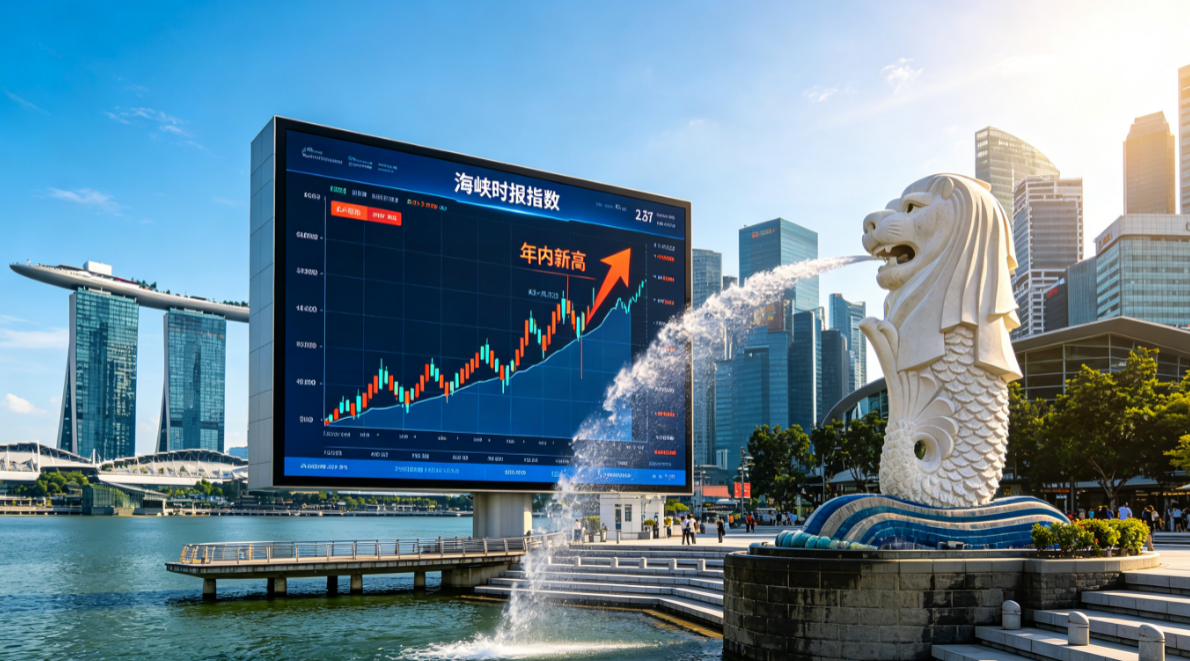
Recently, the Singapore stock market has been quietly making big moves. The Straits Times Index (STI) firmly crossed above 3,400 points, not only rising 1.2% in a single day but also hitting a new high since 2025. For those who have long followed the Singapore market, this performance is not explosive but wins in stability, accuracy, and sustainability, giving a feeling that market sentiment is warming up and funds are indeed voting with their feet.
In this rally, the most eye-catching are none other than financial stocks and REITs. The former support the market's "backbone," while the latter add considerable "flexibility." If the Singapore stock market is a dish, these two types of assets are the most flavor-enhancing ingredients today.
Financials Lead: Banking Sector Remains Market Anchor
On the surface, leading financial stocks like DBS Bank and OCBC Bank rose over 2%, not just following the trend but showing strong performance backed by fundamentals. Singapore bank stocks have always been regarded as core assets of the market, partly because of their stable profitability and partly because of consistently attractive dividend expectations.
Although the market still holds some caution about the global economy, the resilience of Singapore's local economy makes the financial sector feel particularly "reassuring." Corporate loans, wealth management, and cross-border finance continue to contribute revenue to banks, and while the interest rate environment is not as aggressive as a few years ago, it remains in a range favorable to banks. In other words, banks are not making exorbitant profits, but the stability and transparency allow funds to stay long-term with confidence.
For many international investors, Singapore bank stocks have another great advantage: high predictability. Compared to some more volatile market assets, these stocks are more like "defensive top performers," and funds tend to flock to them at the slightest market turbulence.
REITs Active: Interest Rates Stable, Market Finally Breathes
Besides financial stocks, the REITs sector also showed clear activity this time. REITs have always been closely related to the interest rate environment. Over the past period, market concerns about high interest rates once suppressed the sector's performance. But now, as interest rate expectations gradually stabilize, investors' mindsets have relaxed, and REITs naturally face a recovery opportunity.
The logic of such assets is simple: borrowing costs are not as frightening anymore, cash flow distribution becomes more predictable, and yields are more attractive for capital seeking stability. For investors who like cash flow and do not want to bear too much volatility, REITs have always been a significant choice.
More importantly, the Singapore REITs market itself is mature, covering retail, industrial, office, logistics, and other sectors, with a relatively diversified structure. As the market's assessment that "the high interest rate era is near its end" strengthens, REITs naturally become an important direction for fund reallocation.
Why Now? Singapore's Appeal Is Rising
Behind this new high, what really deserves attention is the overall attractiveness of the Singapore market. Market analysts mention that sound economic fundamentals and improved corporate earnings expectations are important reasons for the continuous inflow of international funds. In other words, investors are not simply chasing gains; they are attracted by its "sense of security."
Against a backdrop of global uncertainty, Singapore's advantages become clearer: political stability, transparent regulation, mature financial system, and relatively standardized corporate governance. These factors, which might not seem "exciting," are precisely what funds value most in turbulent times.
Additionally, the valuation of the Singapore market is not as overheated as some hot markets, giving investors some upside potential. For funds seeking stable returns, a market with "determinacy rather than story" is more likely to gain favor.
Outlook: Steady Rise, Key Depends on Two Lines
Whether the Singapore stock market can continue to climb depends on two main lines. First, the global rate path: if rates remain stable or gently decline, the appeal of REITs and high-dividend assets will continue to increase. Second, whether local corporate earnings can sustainably improve, especially in banking, real estate, and consumption-related sectors.
Of course, the market will not rise in a straight line forever. In the short term, profit-taking, external news shocks, and changes in global risk appetite may cause fluctuations. However, from the current situation, the overall character of the Singapore market increasingly resembles a "steady bull" – not necessarily sprinting every day, but often going further and more steadily.
Conclusion: New High Is Just the Beginning, Confidence Is Key
The STI crossing above 3,400 points is certainly a signal worth noting, but more important is not "how many points it broke," but the change in market sentiment and fund logic. Financial stocks provide support, REITs bring recovery, and stable economy and earnings expectations continuously strengthen market confidence.
For investors, such a Singapore stock market may not have many surprises, but it fits well in long-term allocation. After all, in an era full of uncertainty, a market that can consistently deliver certainty is itself of great value.