

SpaceX Bets on Open-Source AI: Reflection AI Signs $6.3 Billion Computing Deal
Keywords: SpaceX, Reflection AI, Colossus, open-source AI, computing cooperation, GB300, AI infrastructure, model competition
Introduction
As AI competition enters a new phase driven by computing power, those who can secure stable, sufficient, and scalable computing resources are more likely to take the lead in the next round of technological rivalry. Recently, open-source AI startup Reflection AI reached a major computing cooperation agreement with SpaceX, becoming the latest external customer to access the Colossus infrastructure. This is not only a staggering commercial deal but also sends a strong signal: the AI industry is rapidly shifting from pure model competition to comprehensive competition in infrastructure, ecosystems, and strategic resources.
1. The Computing Game Behind the Mega Deal
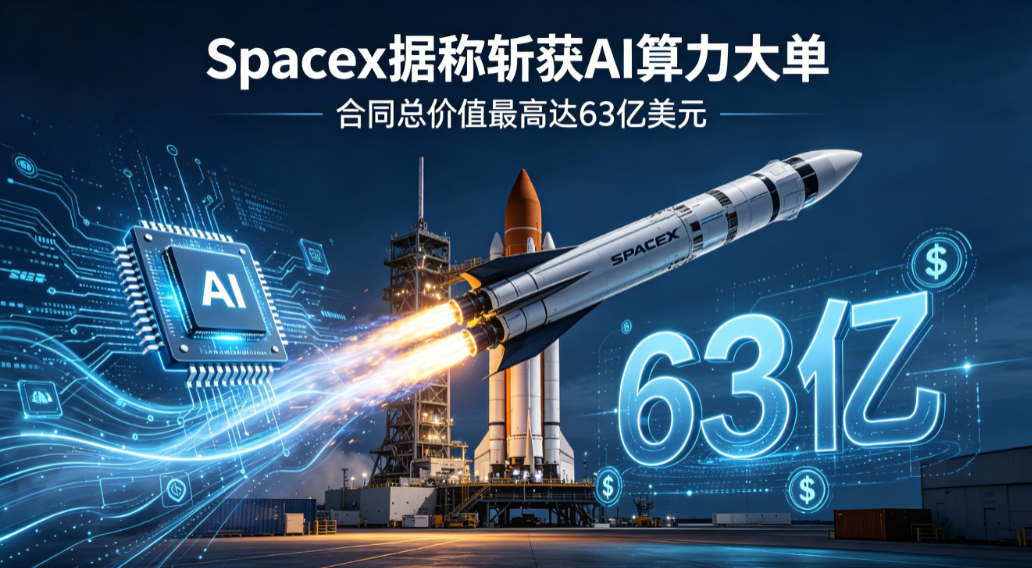
According to publicly disclosed information, Reflection AI will immediately gain access to SpaceX's GB300 for training and running advanced models. Under the agreement, from July 1, 2026 to 2029, Reflection will pay SpaceX $150 million per month; if the agreement runs its full term, total payments will reach about $6.3 billion. For a startup already valued at $25 billion, such an investment scale fully demonstrates its emphasis on computing power and reflects that large model training has entered a "capital-intensive" stage.
More notably, both parties have set a relatively flexible exit mechanism: after the first three months, either party can terminate the contract with 90 days' notice. This means the cooperation embodies both a long-term strategic intent and necessary commercial flexibility, in line with the realistic logic of high-risk, high-investment tech collaborations.
2. SpaceX Transitions from "User" to "Supplier"
Another layer of this transaction lies in the change of SpaceX's role. Previously, the Colossus infrastructure primarily served internal AI projects, especially supporting the R&D of AI products like Grok to gain an edge in competition with rivals such as ChatGPT. Now, SpaceX is opening this massive data center system to external AI companies, marking its shift from infrastructure user to computing power supplier and platform service provider.
In fact, SpaceX has previously established computing collaborations with Anthropic, Google, and Cursor, and is currently pushing forward with the acquisition of Cursor. This indicates that SpaceX is not just temporarily leasing computing power but systematically laying out a commercialization path for AI infrastructure. For a company known for rockets and Starlink, this extension means its business map is expanding into higher value-added digital infrastructure.
3. The Strategic Value of Open-Source AI Is Rising
That Reflection AI became a new customer of SpaceX also reflects the upward trend of the open-source AI route. In recent years, as governments and enterprises reassess their reliance on closed AI systems, the value of open-source models is being re-evaluated. While closed models have advantages in performance and productization, their potential risks are increasingly apparent: supply chain dependence on a single vendor, difficulty auditing model black boxes, limited customization, and uncontrollable long-term costs.
Earlier, Anthropic stopped providing services to Fable and Mythos, triggering market concerns about over-reliance on closed model suppliers for critical business. In contrast, open-source models emphasize customer control: companies and governments can inspect model behavior and customize and deploy autonomously based on their own scenarios. For institutions that value data security, technological sovereignty, and sustainable costs, this flexibility is highly attractive.
Reflection AI is trying to seize this window, building an open-source system that can compete with frontier models from OpenAI, Anthropic, and Google, and proposing a vision of serving "American open intelligence." Although it has not yet officially released a public frontier open-source model, the company has gradually gained recognition in government and national security fields, participating in the U.S. Department of Energy's "Genesis Mission" and related AI programs at the Department of Defense. This shows that open-source does not mean weakness; it may instead become an institutional advantage in the new round of technological competition.
4. The Core of AI Competition Is Shifting to Infrastructure
From an industry perspective, this deal once again proves that computing power has become one of the most critical strategic resources in the AI era. Whether training large models or deploying inference systems, the supply capacity of advanced NVIDIA chips directly determines a company's competitive ceiling. In the infrastructure system composed of chips, data centers, power, and network resources, any shortage can slow down product iteration and commercialization pace.
By opening Colossus to external customers, SpaceX not only gains new revenue sources but also further strengthens its voice in AI infrastructure. For investors, this layout is particularly important: it means SpaceX's growth story no longer relies solely on rocket launches and Starlink business but can extend to long-term high-growth tracks like AI, data centers, and computing services.
Conclusion
The cooperation between Reflection AI and SpaceX appears on the surface to be a $6.3 billion computing deal, but in essence, it is a microcosm of the changing structure of the AI industry. It shows that future competition is not just about which model is stronger, but about whose computing power is more stable, whose ecosystem is more open, and whose infrastructure is more resilient. Between closed and open, centralized and distributed, using and providing, the industry is redefining the AI value chain. It is foreseeable that as more enterprises treat computing power as a core asset, competition around infrastructure will be more enduring and profound than the models themselves.