


Opportunities on Singapore Mainboard Amid the AI Computing Power Wave: Why SGX AI Chip Stocks Are the New Investment Hotspot in 2026?
In 2026, the global AI industry is undergoing an unprecedented "computing power revolution". As the parameter scale of generative AI models exceeds trillions, demand for high-performance computing (HPC) is growing exponentially. Market research institutions predict that global AI computing power demand will reach 1.2 ZFLOPS in 2026, a 45% year-on-year increase, with over 60% of demand coming from large model training and inference. This trend not only drives revenue growth for chip giants like NVIDIA and AMD but also brings new opportunities to various segments of the semiconductor industry chain. As an important hub of Asia's semiconductor industry, Singapore, leveraging policy support, technological accumulation, and industrial ecosystem, has become a key location for AI chip industry layout. AI chip stocks on the Singapore Exchange (SGX) mainboard,凭借技术突破、订单增长和政策红利, are becoming the focus of investors in 2026. This article will analyze AI computing power demand, Singapore's industrial advantages, the performance of SGX AI chip stocks, and investment logic to explain why now is the right time to invest in Singapore's AI chip stocks.
One、AI Computing Power Demand Explosion: The "Super Cycle" of the Semiconductor Industry Begins
The core driver of AI computing power comes from large model training and inference. In 2026, globally, large models like OpenAI's GPT-5, Google's Gemini Ultra, and Meta's LLaMA 3 have parameter scales exceeding trillions. These models require thousands of GPUs to run simultaneously to complete training tasks. For example, GPT-5 training needs about 20,000 H100 GPUs, while Gemini Ultra training requires about 15,000 H100 GPUs. This large-scale computing power demand directly drives the growth in demand for high-performance GPUs, HBM (High Bandwidth Memory), and advanced packaging technologies.
Besides large model training, the popularization of edge AI also intensifies computing power demand. With the rapid development of applications like IoT, autonomous driving, and smart healthcare, edge devices need more efficient AI chips to process local data. For example, autonomous vehicles need to process several GB of data per second, while smart medical devices need to analyze medical images in real time. These applications put higher demands on the energy efficiency ratio, low latency, and reliability of AI chips, driving the growth in demand for specialized AI chips (such as NPUs, ASICs).
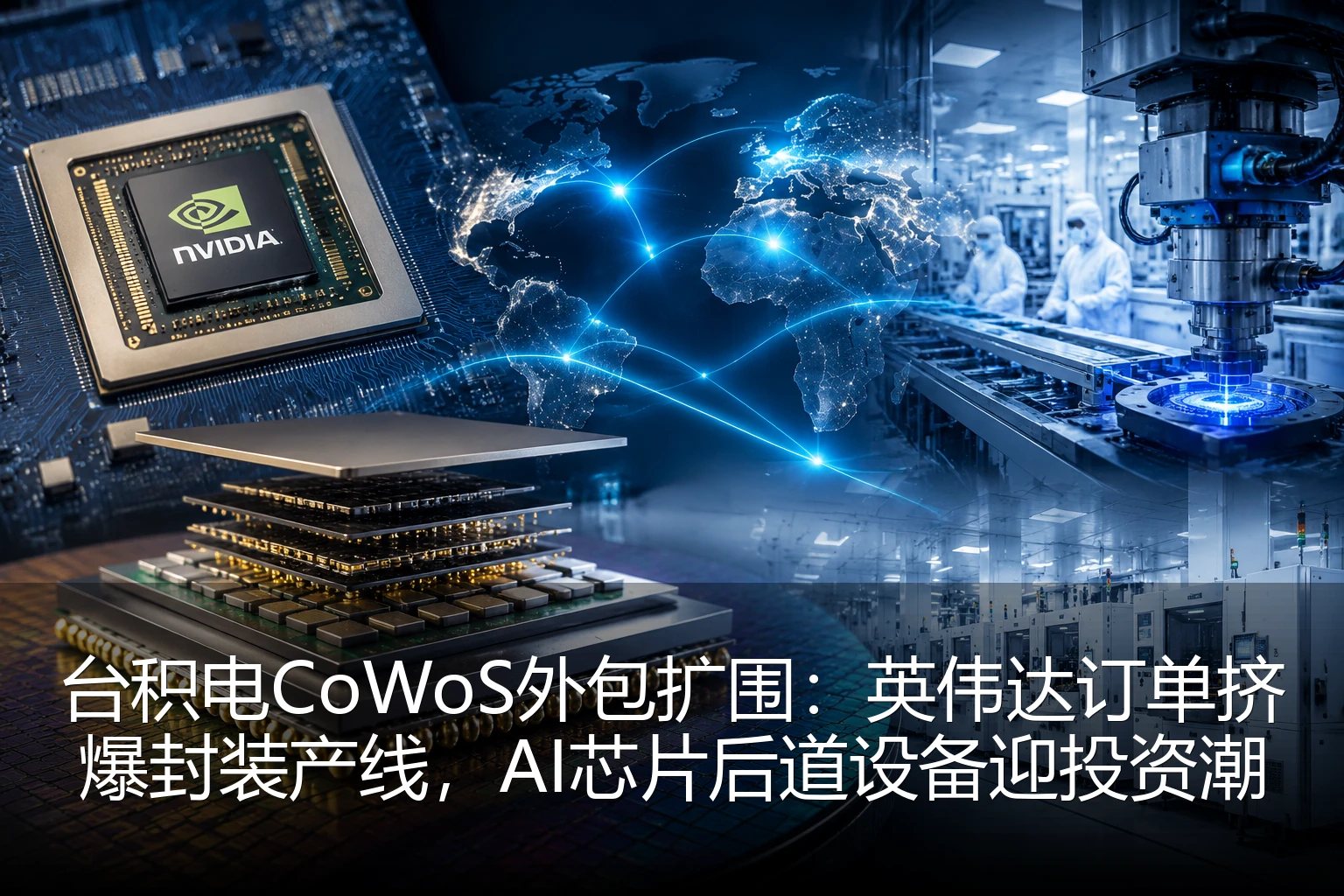
In the semiconductor industry chain, advanced packaging (such as CoWoS, InFO) and HBM have become key segments. Advanced packaging technology can integrate multiple chips (like GPUs, CPUs, HBM) into one package, improving data transmission speed and energy efficiency ratio. For example, NVIDIA's H100 GPU uses CoWoS packaging to integrate the GPU, HBM, and I/O chips, achieving higher bandwidth and lower latency. As the "memory" of GPUs, HBM's capacity and bandwidth directly determine GPU performance. In 2026, the HBM market is expected to reach $15 billion, a 35% year-on-year increase, with Samsung, SK Hynix, and Micron occupying the main market share.
Additionally, silicon photonics technology has become an important development direction for AI chips. Silicon photonics technology uses optical signals for data transmission, which is faster and more energy-efficient than electrical signals. For example, United Microelectronics Corporation (UMC) mass-produces silicon photonics wafers at its 12-inch fab in Singapore for AI optical interconnects, solving the bandwidth bottleneck of traditional electrical interconnects. This technological breakthrough provides a new path for improving AI chip performance.
Two、Singapore's AI Industry Advantages: Triple Drive of Policy, Technology, and Ecosystem
As a key node in Asia's semiconductor industry, Singapore, leveraging policy support, technological accumulation, and industrial ecosystem, has become a key location for AI chip industry layout. First, in terms of policy, the Singapore government attaches great importance to the development of the semiconductor industry. In 2025, it released the "AI National Strategy 2.0", investing S$5 billion to support R&D and application of cutting-edge technologies like semiconductors and AI. The strategy clearly states the goal of building an "Asian Semiconductor Innovation Center" to attract international semiconductor giants to set up R&D centers and production bases in Singapore. For example, TSMC invested S$12 billion to build a 12-inch fab in Singapore, expected to start production in 2027; Samsung Electronics invested S$8 billion to build an HBM production line in Singapore to meet the demand for AI chips.
Second, in terms of technology, Singapore has world-leading semiconductor manufacturing and packaging technologies. For example, GlobalFoundries' 12-inch fab in Singapore has achieved a yield of 99%, exceeding the industry average (about 95%). This high yield enables Singapore's fabs to produce higher-quality AI chips to meet the needs of large model training. Additionally, Singapore's packaging plants (such as STATS ChipPAC) have advantages in advanced packaging, able to provide packaging services like CoWoS and InFO for AI chips. For example, STATS ChipPAC announced in 2026 that it would raise the prices of advanced packaging due to the surge in demand for AI chips, with production capacity running at full load.
Finally, in terms of ecosystem, Singapore has gathered many international semiconductor giants and local enterprises, forming a complete industry chain. For example, fabs like TSMC, Samsung, and UMC have production bases in Singapore; packaging and equipment companies like STATS ChipPAC and UMS Holdings operate in Singapore; AI chip companies like Enbaco and AEM are listed on the SGX mainboard. This complete industry chain enables Singapore to quickly respond to the demand for AI chips, providing one-stop services from wafer manufacturing to packaging and testing.
Three、Performance of SGX AI Chip Stocks: Dual Growth in Performance and Orders
With the explosion of AI computing power demand, AI chip stocks on the SGX mainboard have performed impressively, achieving dual growth in performance and orders. Here is an analysis of several representative companies:
1. UMS Holdings (Singapore-based Semiconductor Equipment Provider)
UMS Holdings is a leading semiconductor equipment provider in Singapore, mainly offering packaging and testing equipment. Its Q2 2026 financial report shows a 120% year-on-year increase in net profit to S$120 million, mainly due to the surge in demand for AI chip packaging. UMS Holdings' equipment is widely used in the packaging and testing of AI chips, such as HBM packaging and GPU testing. With the increase in orders from chip giants like NVIDIA and AMD, UMS Holdings' production capacity is running at full load, and its order backlog has reached a historical high. Additionally, UMS Holdings has launched new AI chip testing equipment, improving testing efficiency and accuracy, further consolidating its market position.
2. Enbaco (Fabless AI Chip Stock)
Enbaco is the first fabless AI chip company listed on the SGX mainboard, focusing on the R&D and sales of edge AI chips. In 2026, Enbaco's orders increased by 80% year-on-year to $50 million, mainly from the smart healthcare and autonomous driving sectors. Enbaco's chips use advanced 7nm technology, with low power consumption and high energy efficiency ratio, suitable for edge devices. For example, its latest edge AI chip has a power consumption of only 5W but performs 10 times better than traditional GPUs, meeting the needs of smart medical devices to analyze medical images in real time. Additionally, Enbaco has collaborated with Singaporean medical institutions to launch an intelligent diagnostic system based on its chips, gaining market recognition.
3. STATS ChipPAC (Packaging Plant)
STATS ChipPAC is a leading packaging plant in Singapore, mainly providing advanced packaging services. In the second half of 2026, STATS ChipPAC announced that it would raise the prices of advanced packaging due to the surge in demand for AI chips, with production capacity running at full load. Its advanced packaging capacity utilization reached 95%, higher than the industry average (about 80%). STATS ChipPAC's CoWoS packaging services are widely used in NVIDIA's H100 GPU and AMD's MI300 GPU. With the increase in AI chip orders, STATS ChipPAC's revenue is expected to increase by 40% year-on-year to S$3 billion. Additionally, STATS ChipPAC plans to expand its capacity in Singapore to meet future AI chip demand.
Four、Investment Logic and Risk Warnings
For investors, AI chip stocks on the SGX mainboard have the following investment logic:
- Policy Dividends: The "AI National Strategy 2.0" released by the Singapore government provides policy support for the semiconductor industry, including tax incentives and R&D subsidies, reducing corporate operating costs and improving profitability.
- Market Demand: The explosion of AI computing power demand brings new opportunities to various segments of the semiconductor industry chain, and SGX AI chip stocks directly benefit from this trend, with strong and certain performance growth.
- Technological Breakthroughs: Singapore's semiconductor enterprises have technological advantages in fields like advanced packaging and silicon photonics, able to meet the high-performance needs of AI chips, enhancing product competitiveness.
- Valuation Advantage: Compared to AI chip stocks in the US market (such as NVIDIA, AMD), SGX AI chip stocks have lower valuations, offering higher investment cost-performance. For example, UMS Holdings has a P/E ratio of about 20 times, while NVIDIA's P/E ratio is about 50 times.
Of course, investing in SGX AI chip stocks also carries certain risks:
- Global Semiconductor Cycle Fluctuations: The semiconductor industry is cyclical. If global economic growth slows down, demand for AI chips may decline, affecting corporate performance.
- Technological Iteration Risk: The technological iteration of AI chips is fast. If enterprises cannot keep up with the pace of technological development, they may lose market competitiveness.
- Geopolitical Impact: The semiconductor industry is greatly affected by geopolitics. If Sino-US trade friction intensifies, it may affect corporate supply chains and orders.
Overall, as AI computing power demand continues to grow, Singapore's semiconductor industry chain advantages will become more prominent, and AI chip stocks on the SGX mainboard are expected to become the new investment hotspot in 2026. Investors should focus on enterprises' technical strength, order growth, and performance, and choose companies with competitive advantages for investment.