


In recent years, generative AI applications represented by ChatGPT and Sora have rapidly gained popularity, driving global computing power demand to grow exponentially. According to industry data, the global AI computing power market size is expected to exceed $1 trillion by 2026, with AI chips, as the core carrier of computing power, seeing demand growth far outpacing traditional chips. Against this backdrop, Singapore, with its unique policy advantages and semiconductor industry chain layout, has become an important destination for global AI chip investment. This article will deeply analyze the investment logic of Singapore's AI chip stocks from four dimensions: the current status of AI computing power development, Singapore's policy dividends, industrial chain synergy, and local company performance.
1. AI Computing Power Demand Explosion: The New Engine of the Global Semiconductor Industry
The rise of generative AI has fundamentally changed the structure of computing power demand. Taking NVIDIA as an example, the computing power of its H100 GPU is 9 times higher than the previous generation A100, and the computing power required to train the GPT-4 model is more than 100 times that of GPT-3. This explosion in computing power demand has directly driven the comprehensive prosperity of the AI chip industry chain. From upstream wafer manufacturing (such as TSMC's 3nm process), midstream packaging and testing (such as CoWoS packaging), to downstream storage chips (such as HBM), every link has ushered in unprecedented growth opportunities.
It is worth noting that the demand for AI chips comes not only from data centers but also from edge computing, autonomous driving, smart terminals, and other fields. For example, autonomous vehicles need to process several GB of data per second, placing extremely high demands on the real-time performance of AI chips; while edge AI devices need to achieve efficient computing at low power consumption, which poses new challenges for the design and manufacturing of AI chips. Singapore, with its deep accumulation in the semiconductor field, especially its advantages in advanced packaging and silicon photonics technology, can meet these diversified demands.
1.1 Wafer Manufacturing: Capacity Expansion of TSMC and Samsung
Wafer manufacturing is the core upstream link of the AI chip industry chain. As the world's leading wafer foundry, TSMC's 3nm process has achieved full production, and orders are locked until 2027, with AI chip orders accounting for more than 60%. TSMC's 12-inch wafer fab in Singapore (Fab 18) is accelerating capacity expansion, with an expected monthly capacity of 100,000 wafers by 2027, mainly serving AI chip customers. In addition, Samsung Electronics is also deploying its 3nm GAA process in Singapore, with a yield breakthrough to 70%, although still lower than TSMC's 90%, Samsung is trying to capture more market share in AI chips by expanding capacity.
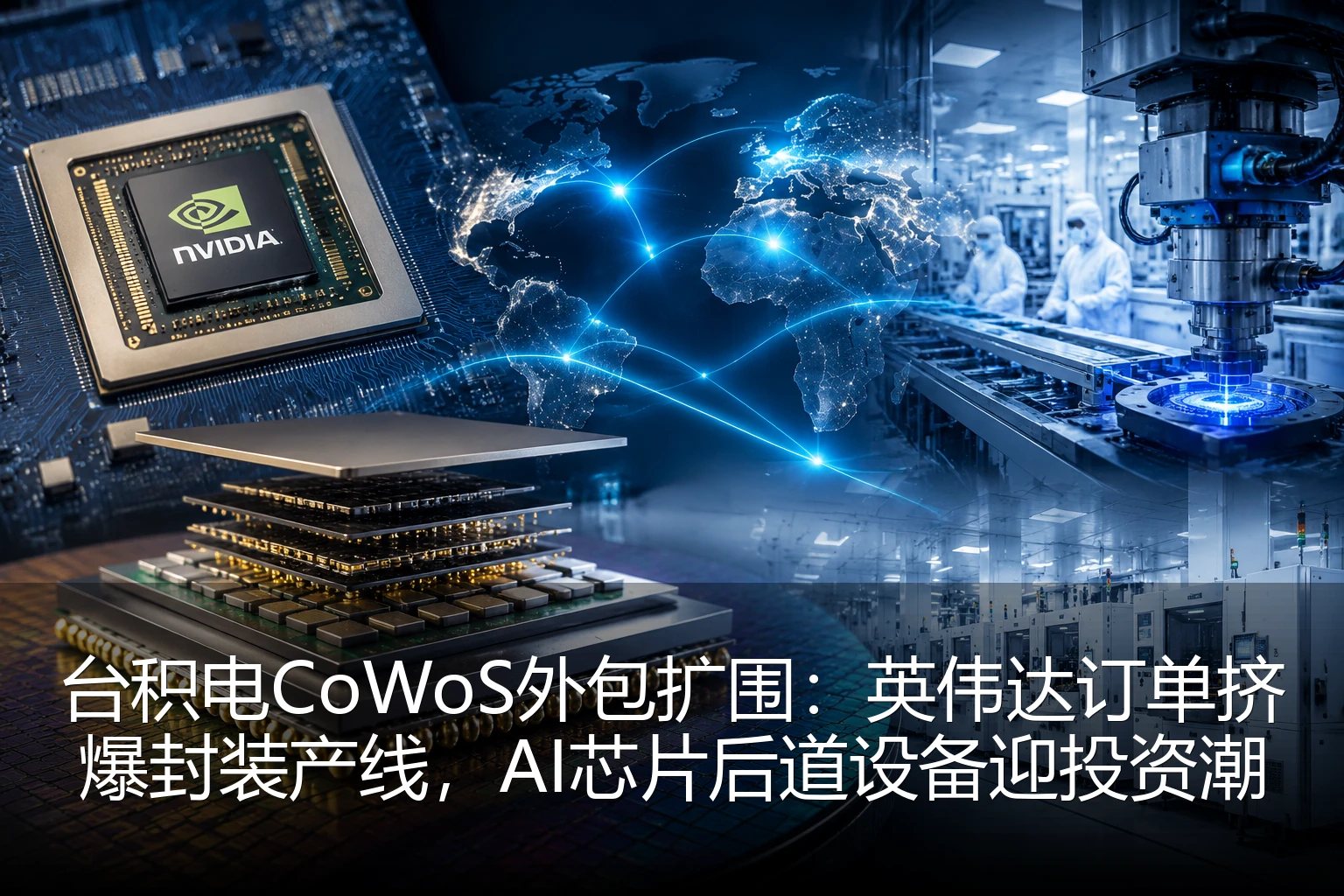
The capacity expansion in the wafer manufacturing link directly drives the demand for downstream packaging and testing. For example, TSMC's CoWoS packaging technology is facing capacity tension due to a surge in NVIDIA orders, forcing it to outsource part of the work to STATS ChipPAC in Singapore, which brings new growth opportunities for Singapore's packaging and testing enterprises.
1.2 Packaging and Testing: Explosive Growth of Advanced Packaging
Advanced packaging is key to improving the performance of AI chips. CoWoS (Chip-on-Wafer-on-Substrate) packaging technology can stack multiple chips together, increasing data transmission speed and reducing power consumption, making it the preferred packaging method for AI chips. NVIDIA's H100 GPU uses CoWoS packaging, with a monthly capacity of 100,000 units, but still cannot meet market demand. To this end, TSMC had to outsource part of its CoWoS to STATS ChipPAC in Singapore, which announced a 15% increase in packaging prices in the second quarter of 2026, showing strong demand for AI chip packaging.
Besides STATS ChipPAC, UMS Holdings in Singapore is also a leader in the advanced packaging field. Its Q2 financial report shows that net profit increased by 120% year-on-year, mainly due to a surge in orders for AI chip packaging equipment. UMS Holdings' advanced packaging equipment has been applied to the production lines of customers such as TSMC and Samsung, demonstrating its core position in the AI chip industry chain.
2. Singapore's Policy Dividends: Long-term Support from AI National Strategy 2.0
The Singapore government attaches great importance to the development of the AI industry and released the "AI National Strategy 2.0" in June 2026, proposing to make Singapore a global AI innovation center by 2030. The strategy includes four key focuses: strengthening AI R&D, cultivating AI talent, promoting AI applications, and improving the AI ecosystem. Among them, for the semiconductor industry, the government launched the "Semiconductor Industry Support Plan" to provide tax incentives, R&D subsidies, and land support for AI chip companies.
For example, the Singapore Economic Development Board (EDB) cooperated with TSMC to build a 12-inch wafer fab in Singapore, and the government provided subsidies of up to S$5 billion to support capacity expansion and technology R&D. In addition, Singapore has established the "AI Chip Innovation Fund" with a scale of S$1 billion to invest in local AI chip startups, such as Enmotec, which is Singapore's first fabless AI chip company, focusing on edge AI chip design, and its products have been applied in smart homes, industrial IoT, and other fields.
Policy dividends are not only reflected in financial support but also in talent introduction and industrial synergy. Singapore has attracted a large number of semiconductor experts, including executives from TSMC and Samsung, through the "Global Talent Program", providing talent guarantees for the development of the AI chip industry. At the same time, Singapore's universities (such as the National University of Singapore, Nanyang Technological University) cooperate with the industry to offer specialized courses such as AI chip design and advanced packaging, cultivating talents that meet industrial needs.
3. Industrial Chain Synergy: Competitive Advantages of Singapore's Semiconductor Ecosystem
Singapore's semiconductor industry chain has a complete synergy effect, forming a closed loop from upstream wafer manufacturing, midstream packaging and testing, to downstream design and sales. This synergy enables Singapore to quickly respond to changes in AI chip demand, reduce production costs, and improve efficiency.
First, in the upstream wafer manufacturing link, the layout of TSMC and Samsung in Singapore provides high-quality wafers for AI chips. For example, TSMC's 3nm process can meet the needs of high-end AI chips, while Samsung's 3nm GAA process offers a more cost-effective alternative. Second, in the midstream packaging and testing link, companies such as STATS ChipPAC and UMS Holdings can provide advanced packaging technologies such as CoWoS and silicon photonics packaging to meet the high-performance requirements of AI chips. Finally, in the downstream design link, startups like Enmotec can leverage Singapore's industry chain advantages to quickly transform designs into products and launch them to the market.
In addition, Singapore's semiconductor industry chain also has geographical advantages. As the financial and technological center of Southeast Asia, Singapore can connect markets in Asia, Europe, and the Americas, providing global sales channels for AI chip companies. For example, Enmotec's products have been sold to the United States, Europe, and China, while UMS Holdings' equipment is exported to the global production lines of TSMC and Samsung.
4. Local Company Performance: Direct Beneficiaries of AI Chip Demand
Singapore's AI chip-related companies have shown outstanding performance, becoming the focus of investors' attention. The following is an analysis of several representative companies:
- Enmotec: As Singapore's first fabless AI chip company, Enmotec focuses on edge AI chip design, with its products featuring low power consumption and high performance. In the first half of 2026, Enmotec's revenue increased by 80% year-on-year, mainly due to order growth in the smart home and industrial IoT fields. The company plans to launch a new generation of edge AI chips in 2027, with computing power increased by 50% and power consumption reduced by 30%, which is expected to further expand its market share.
- UMS Holdings: UMS Holdings is a leading semiconductor equipment manufacturer in Singapore, focusing on advanced packaging equipment. Its Q2 financial report shows that net profit increased by 120% year-on-year, mainly due to a surge in orders for AI chip packaging equipment. The company expects its full-year revenue in 2026 to grow by 150%, with AI chip-related equipment accounting for more than 70%. UMS Holdings' advanced packaging equipment has been applied to the production lines of customers such as TSMC and Samsung, demonstrating its core position in the AI chip industry chain.
- STATS ChipPAC: STATS ChipPAC is a packaging and testing enterprise in Singapore, focusing on CoWoS packaging. In the second quarter of 2026, STATS ChipPAC increased packaging prices by 15%, showing strong demand for AI chip packaging. The company expects its full-year revenue in 2026 to grow by 100%, with AI chip packaging accounting for more than 60%. STATS ChipPAC's capacity has reached 50,000 units per month, but still cannot meet market demand, and plans to increase capacity to 80,000 units per month in 2027.
5. Investment Logic and Risk Warnings
Based on the above analysis, the investment logic of Singapore's AI chip stocks mainly includes the following points:
- Policy Dividends: The strong support from the Singapore government provides a long-term development environment for the AI chip industry.
- Market Demand: The explosion of AI computing power demand has driven the comprehensive growth of the AI chip industry chain.
- Industrial Chain Synergy: Singapore's complete semiconductor industry chain enables enterprises to quickly respond to demand and reduce costs.
- Performance: Outstanding performance of local companies shows that they are direct beneficiaries of AI chip demand.
However, investing in AI chip stocks also carries certain risks. First, the technological iteration speed of AI chips is extremely fast, and companies that cannot keep up with technological progress may be eliminated. Second, the competition in the global semiconductor industry is intensifying, and giants like TSMC and Samsung may capture more market share, squeezing the survival space of local enterprises. In addition, geopolitical risks may also affect the stability of the industry chain, such as Sino-US trade frictions may lead to supply chain disruptions.
6. Conclusion: Investment Opportunities in Singapore's AI Chip Stocks
As AI applications continue to deepen, computing power demand will continue to grow. Singapore, leveraging its policy advantages and industrial chain synergy, has become a hotbed for AI chip investment. Local companies such as Enmotec, UMS Holdings, and STATS ChipPAC have shown strong performance growth and are expected to further benefit from the explosion of AI chip demand in the future. For investors, paying attention to the technological progress, capacity expansion, and order growth of these companies will be the key to seizing investment opportunities in AI chips.