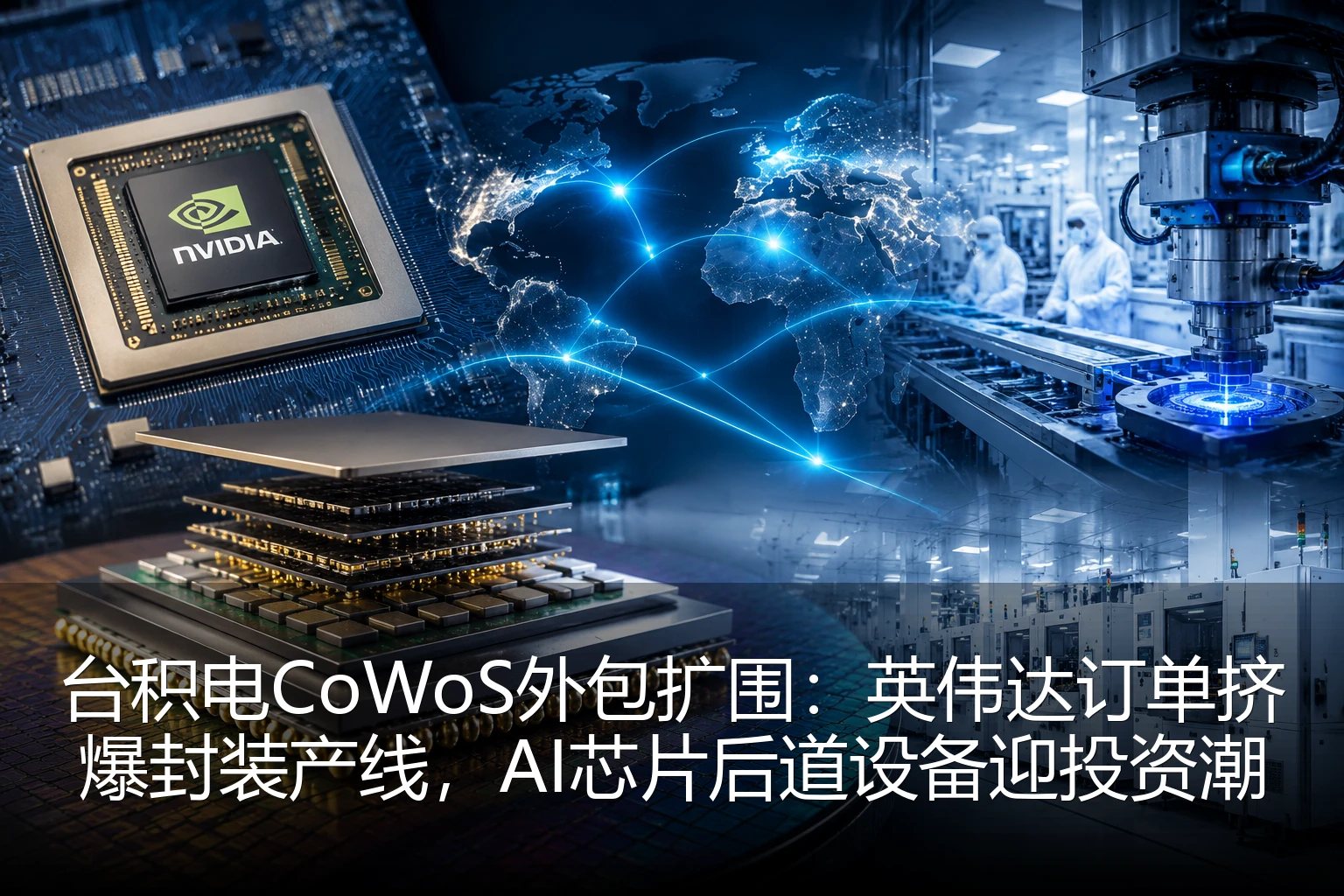



Samsung HBM4 R&D Accelerates, AI Memory Track Enters New Arms Race
As the generative AI wave continues to sweep the globe, High Bandwidth Memory (HBM), a key bottleneck for AI computing power, is becoming a fiercely contested strategic high ground for semiconductor giants. According to South Korean semiconductor industry sources, Samsung Electronics has significantly adjusted its 6th-gen HBM4 development roadmap, planning to complete key customer validation and begin large-scale shipments by the end of 2026. This move is interpreted by the market as a direct assault on SK Hynix's long-standing dominance in the HBM market and will profoundly impact the Asian semiconductor supply chain, particularly Singapore's packaging, testing, and equipment sectors.
HBM4: The Lifeline for AI Chip Performance Leaps
If HBM3E is the current baseline for training large AI models, HBM4 is a necessity for the next generation of trillion-parameter model inference. HBM4 represents a qualitative leap over HBM3E in data transfer rates, bandwidth density, and energy efficiency, with single-stack bandwidth expected to exceed 1.6TB/s. For NVIDIA's Rubin series, AMD's next-gen Instinct, Google's TPUs, and other custom ASICs, whoever can first secure a stable supply of HBM4 will gain the upper hand in the 2027 AI compute race.
Previously, the HBM market was almost monopolized by SK Hynix, whose HBM3E products long held the vast majority share in NVIDIA's H200/B200 and other flagship chips. Although Samsung fell behind on HBM3E due to yield issues, it has adopted a more aggressive technology path for HBM4. Samsung has not only introduced Hybrid Bonding technology to increase stacking layers but also plans to integrate logic and memory chips into a single package, attempting to overtake on the curve at the HBM4 node.
Capacity Expansion Triggers Supply Chain Butterfly Effect
Samsung Electronics' HBM4 ambitions are inseparable from massive capital expenditure. Reports indicate Samsung has initiated expansion plans at its Pyeongtaek and Cheonan plants in South Korea and has begun placing huge procurement orders with global semiconductor equipment suppliers. This wave of capital spending is rapidly transmitting across the entire Asian supply chain: high-end material suppliers in Japan, precision testing and packaging equipment makers in Singapore, and backend assembly and test facilities in Malaysia will all directly benefit from this expansion cycle.
For investors on the Singapore Exchange (SGX) Mainboard, this is not a distant conceptual hype but a tangible order-driven opportunity. Take AEM Holdings, a giant in Singapore's semiconductor supply chain for equipment testing, as an example. As a core supplier of memory chip test handlers, its product average selling price and gross margin are expected to significantly improve against the backdrop of increasing HBM stacking layers and exponentially rising test complexity. Similarly, UMS Holdings, which provides high-precision wafer transfer systems and vacuum chambers, sees its semiconductor division revenue highly positively correlated with the capital expenditure of global memory giants. Samsung's aggressive expansion is undoubtedly a direct endorsement of the performance of related Singapore supply chain companies.
Deep Integration of Memory Cycles and the AI Compute Track
From a chip cycle research perspective, the cyclicality of traditional memory chips (DRAM/NAND) is being smoothed out by AI demand. As a fusion of 'memory + compute', HBM demand no longer completely follows the prosperity cycles of the traditional PC or mobile phone markets. The arms race among NVIDIA, AMD, Intel, and cloud providers' custom chips has kept HBM in a state of persistent undersupply. Samsung's increased bet on HBM4 is not just to fight for market share but, more importantly, to secure long-term influence in the AI compute track.
It is worth noting that the packaging difficulty of HBM4 far exceeds that of previous generations. Due to the higher integration of logic and memory dies, the requirements for packaging cleanliness, thermal management, and test yield are extremely stringent. This is precisely where Singapore's semiconductor supply chain holds its traditional advantages—Singapore hosts a concentration of high-end back-end process solution providers. As the competition between Samsung and SK Hynix extends from wafer fabrication to advanced packaging, Singapore's strategic position as a critical node in the global semiconductor supply chain will be further highlighted.
Investment Insights: Focus on Structural Opportunities in SGX Semiconductor Sector
For SGX Mainboard investors, the capital expenditure expansion phase of memory chip giants is often the best window to allocate semiconductor equipment stocks. With Samsung's HBM4 R&D and production ramp-up, and Micron and SK Hynix following suit, global HBM capacity will see an explosive period from H2 2026 to 2027. This is not just a feast for South Korean companies but also a golden period for the performance realization of Singapore's semiconductor-related concept stocks.
We recommend focusing on blue-chip tech stocks on the SGX Mainboard with capabilities in precision semiconductor testing and packaging equipment manufacturing, as well as hidden champions providing core components to global memory giants. In the investment logic for AI concept stocks, rather than chasing high-valued AI compute leasing stocks, it is better to dig deep into the equipment and materials segments of the supply chain that possess technical barriers and reasonable valuations. Samsung's HBM4 charge has sounded, and a new round of value restructuring in the Asian semiconductor supply chain is underway.